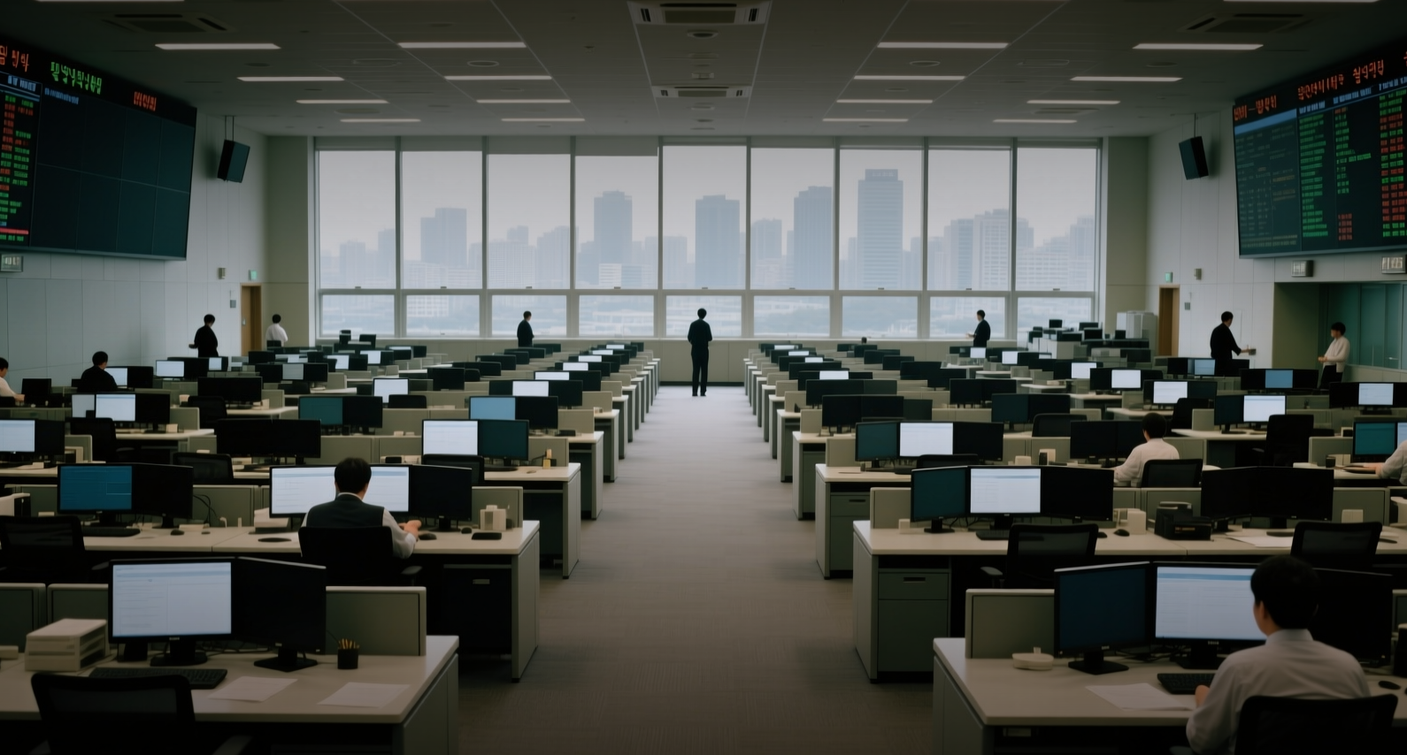
South Korea's Kospi, the world's hottest market of 2025, has turned into a $2.5 trillion fright ride.
South Korea's Kospi plunged about 40 percent in six weeks, erasing $2.5 trillion as the artificial-intelligence boom that tripled the index unwound.
"The volatility is just too severe. This isn't sound investing. It's a gambling table, a casino," said Jung Eui-jung, head of the Korea Stockholders' Alliance, which represents the country's roughly 14 million individual investors.
The collapse burned hundreds of thousands of South Korean retail investors, who account for 60 percent to 70 percent of the Kospi's daily trading volume. The benchmark more than tripled in value, driven by faith in memory-chip makers Samsung Electronics and SK Hynix, which soared to trillion-dollar valuations and accounted for more than half the exchange's value by mid-2026. The index has since rebounded about 20 percent from its low.
The fallout extends beyond Seoul. The Kospi's slide helped drag Asia's stock-picking hedge funds down a record 15.2 percent in July, according to Goldman Sachs, and contributed to a 67 percent loss at the AI-focused hedge fund Situational Awareness, which liquidated most of its public equities portfolio.
The crash was set up in May, when South Korea launched its first single-stock leveraged exchange-traded funds. Using debt and derivatives, the ETFs let retail investors double their bets on Samsung and SK Hynix — a 5 percent daily gain in the stock produced a 10 percent gain in the ETF, and losses compounded the same way. Demand was so intense that the website crashed for days after the May 27 launch. By June, the Kospi crossed 9,000 points, more than three times its 2025 level.
Then concerns over the strength of AI demand and encroaching Chinese competition punctured the semiconductor rally. The Kospi entered a technical bear market after falling more than 20 percent from its June peak, and at one point extended its drop to 43 percent after SK Hynix earnings missed lofty AI-fueled estimates. The index remains the world's top-performing major market in 2026 despite the correction, with Nomura targeting 10,000 to 11,000 and Citi downgrading the market to neutral over volatility.
The pain fell hardest on the "ants" — South Korea's individual investors, known for collective power despite individual weakness. Yoon Jae-Yi, a 30-year-old English teacher, lost $19,000 and has cut her living expenses, skipping meals she tells herself doubles as a diet. Jake Cheong, a 30-year-old accountant, put about $29,000 into a leveraged ETF tracking SK Hynix after the stock jumped 40 percent in three weeks; his position has since fallen 69 percent to roughly $9,000. "My hard rule used to be that when too many people seem to be boasting about their stock gains, we've probably hit the peak," Cheong said. "But FOMO got the better of me."
Leveraged ETFs Turned a Boom Into a Casino
Margin loan balances rose by $7.9 billion to $27.1 billion in six months as more investors tried to boost returns. The boom drew American money too: Roundhill Investments' DRAM ETF, which tracks memory manufacturers including Samsung and SK Hynix, became the most successful ETF launch in U.S. history within weeks, and Interactive Brokers became the first major U.S. brokerage to offer direct trading in Korean equities in May.
The market's gyrations rippled across Asia. Japan's Nikkei 225 fell nearly 3 percent on a global tech rout that tracked the Kospi's slide, with semiconductor stocks leading declines, while the MSCI Asia Pacific Index dropped 2.2 percent on one of the worst sessions. The Kospi 200 volatility index, a gauge of market risk, fell to 56.76 on Monday from 86.18 on July 30, according to the Korea Exchange.
Political Fallout Spreads to the Presidential Office
President Lee Jae Myung, a self-described ant who pledged to nearly double the Kospi to a record 5,000 points by 2030, has seen his approval rating fall to 43.3 percent, the lowest since he took office in June last year. Opposition lawmakers have called for inquiries into the ruling party's handling of the turmoil, and presidential chief of staff for policy Kim Yong-beom faces a criminal complaint alleging he improperly pressured regulators to approve single-stock leveraged products. He denies the allegations.
Regulators have since put in place emergency measures: approval of new single-stock leveraged products is on hold, the mandatory cash deposit to trade them was tripled to roughly $21,000, and a mandatory online training course now tracks mock investments through hours of trading exercises. Jung still wants regulators to delist the leveraged ETFs and devise rescue measures for investors who suffered deep losses. "To return to a normal investing environment, the government must not sit back," he said. "Major surgery is needed."
This article is for informational purposes only and does not constitute investment advice.