
Samsung Electronics' shares have fallen 25% from early-June highs, with the market pricing out virtually all AI-driven earnings growth for the memory maker.
Samsung Electronics' shares have fallen 25% from early-June highs, with the market pricing out virtually all AI-driven earnings growth for the memory maker.
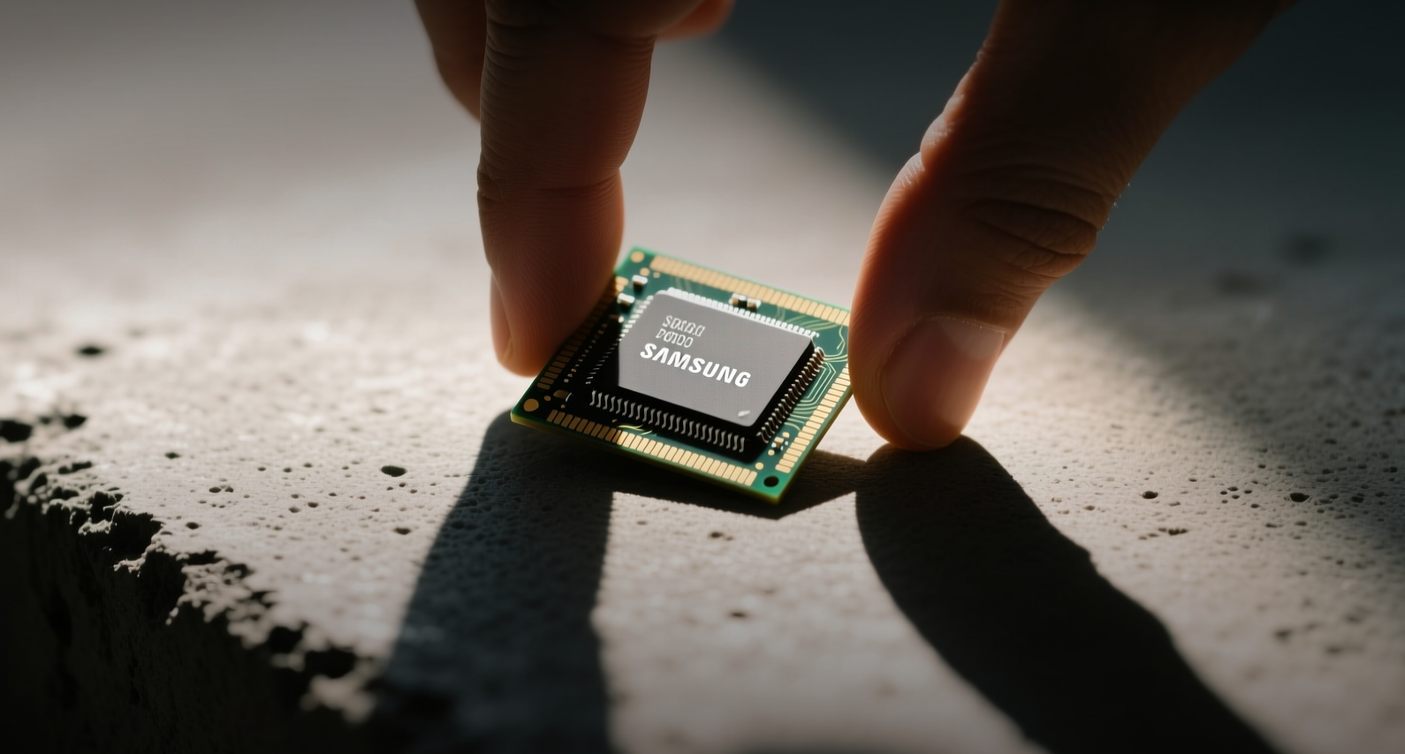
Memory supply grows about 20% a year while demand rises 200%, Elon Musk said on SpaceX's first earnings call, a supply-demand gap that analysts say supports Samsung Electronics' beaten-down shares.
"Unless the market expects Samsung to lose money in 2027, the downside is limited," Justin Park, a trader at Goldman Sachs' Seoul office, said in a note citing Musk's remarks.
HSBC's Aug. 3 model shows Samsung's implied long-term trend earnings per share has fallen to 0.8 times its 2024 level from about 2 times, meaning investors have priced out not just AI gains but the pre-AI earnings base. The stock is down about 25% from early-June highs, with the implied earnings cycle compressed to 2.5 years from 3.5 years and the compound annual growth rate for years three through nine at roughly negative 35%, a historic low.
The question is whether AI memory demand holds. Foreign investors have net sold about $150 billion of Samsung, SK Hynix and TSMC shares this year, about $60 billion of it since June, but the most disruptive mechanical selling may be easing as leveraged ETFs deleverage.
Musk, speaking on SpaceX's Aug. 4 earnings call, called memory the "limiting factor" in AI development. "Memory output is increasing by around 20% a year," he said. "Ask yourself: is the demand increasing by 20% a year? No, the demand is increasing by 200% a year, maybe higher." He called the resulting price pressure "Economics 101."
The comments carry weight beyond SpaceX, which is building AI compute infrastructure at its Colossus data centers and renting capacity to customers including Anthropic. Musk's view of memory as the binding constraint echoes a broader industry debate over whether high-bandwidth memory (HBM, the fast memory stacked alongside AI accelerators) can keep pace with GPU demand from Nvidia and others. Nvidia, the world's most valuable company at a market value above $5 trillion, is the primary buyer of HBM from Samsung, SK Hynix and Micron.
Park's argument rests on Samsung's book value per share (BVPS, the accounting value of equity divided by shares outstanding). When a stock trades near or below that level, the market is pricing the company for liquidation rather than normal operation, he said. If investors do not believe Samsung will post a loss in 2027, the current price acts as a floor.
HSBC's Monte Carlo analysis, which ran 100,000 simulations of 15-year earnings paths to match the current share price, reached a similar conclusion from a different angle. The implied trend EPS of 0.8 times 2024 levels means the market assumes AI has not lifted Samsung's permanent earnings power at all — and that even pre-AI profitability is at risk.
The most destructive selling may be fading. Assets in single-stock 2x leveraged ETFs tracking Korean memory names have shrunk to about $12 billion from $37 billion at the end of June, and their share of trading on volatile days has fallen, HSBC said. That reduces the forced, mechanical selling that worsened the decline.
The outcome hinges on whether AI memory demand sustains. Samsung trades near book value with the market pricing a worst-case earnings path; if demand holds, the implied assumptions embedded in the share price leave room for a re-rating. If it does not, the floor Park identifies could still give way.
This article is for informational purposes only and does not constitute investment advice.
