


OpenAI has quietly become one of Apple's largest hardware customers, buying tens of thousands of Macs for reinforcement learning.
OpenAI has quietly become one of Apple's largest hardware customers, buying tens of thousands of Macs for reinforcement learning.
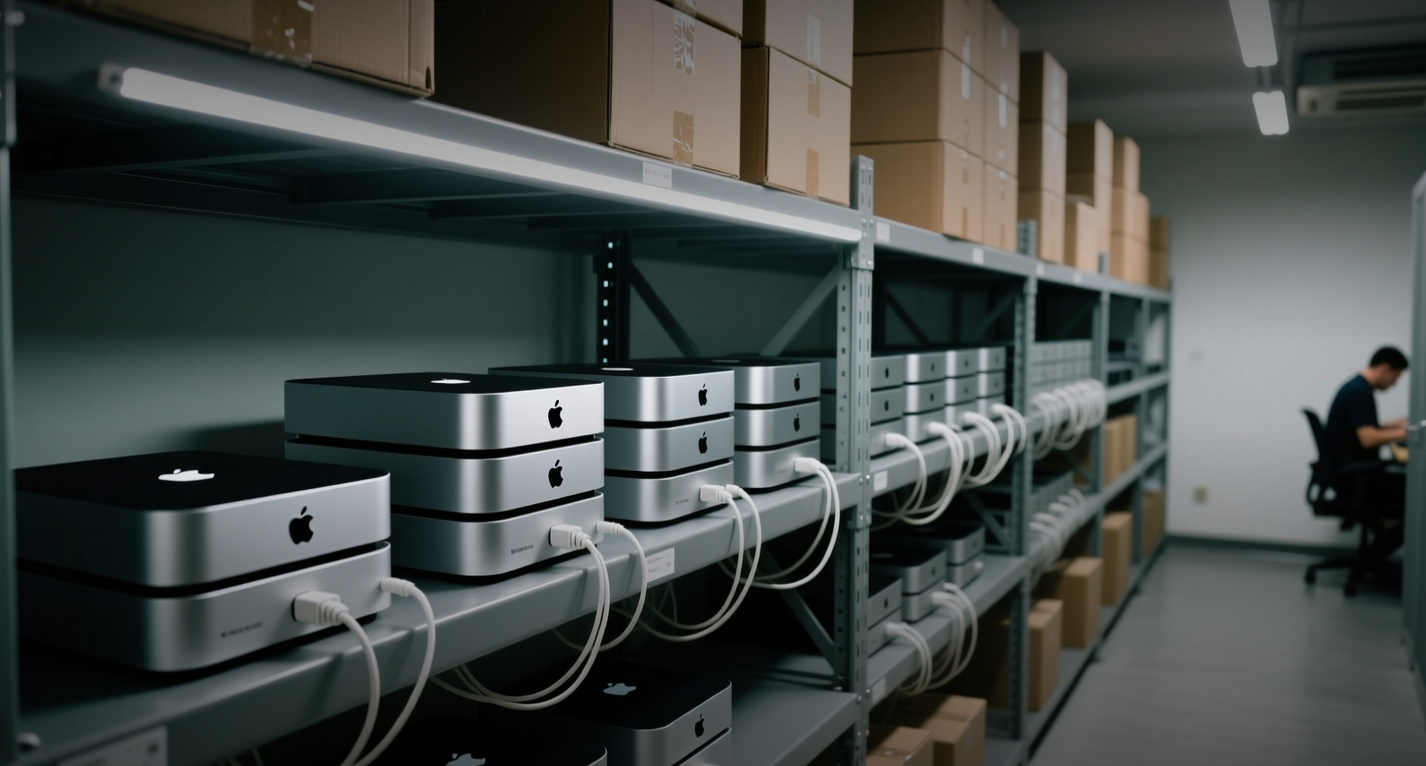
OpenAI has bought tens of thousands of Mac minis for reinforcement learning, lifting Apple's Mac revenue nearly 29 percent to $10.3 billion and drawing Nvidia's attention.
"The Mac's surge in the enterprise AI market was entirely accidental, not the result of proactive planning," Todd Dailey, Apple's former enterprise marketing manager for AI products who left in April, said. "Apple has no dedicated engineering team for enterprise customers."
The machines train "computer-use agents" — AI systems that operate browsers, edit code, and organize inboxes — a workload of thousands of small, parallel episodes that suits Apple's unified memory architecture, where CPU and GPU share a single pool of RAM. Anthropic is renting Mac minis through Amazon Web Services for similar tasks. High-end Mac mini and Mac Studio configurations have been out of stock for months as AI data centers drain memory-chip supply.
The purchase is a rounding error against OpenAI's $50 billion 2026 computing budget, but it marks the first time a frontier lab has treated consumer hardware as core AI infrastructure. Nvidia, which launched the $4,699 DGX Spark desktop AI computer in response, now regards Apple as its biggest competitor in local AI.
The appeal lies in Apple silicon's shared memory pool. Nvidia GPUs keep video memory separate from system memory, creating a bottleneck when data moves between them; Apple's M-series chips let the CPU and GPU access the same block directly. The M5 Ultra reaches 512GB of unified memory — enough to load quantized models with tens of billions of parameters without the complexity of a multi-GPU cluster. Dedicated fans in the Mac mini and Mac Studio sustain performance during training runs lasting hours or days, unlike the thermally constrained MacBook.
Apple is promoting the EXO Labs open-source project, which clusters multiple Macs to run trillion-parameter models locally. The new Mac Studio, released in August — earlier than the usual October or November cycle — emphasizes multi-machine clustering. Independent benchmarks show a cluster of eight Mac mini M4 Pro units serving DeepSeek V3 671B at roughly 5.37 tokens per second, a low-cost inference path that did not exist a year ago.
Nvidia's DGX Spark, a Mac-mini-sized desktop AI computer built on the GB10 Grace Blackwell superchip with 128GB of unified memory, launched at $3,999 in October and has since climbed to $4,699 as memory shortages bite. ASUS's first production run of RTX Spark systems sold out to distribution partners before reaching store shelves. Nvidia's own DGX Spark is dramatically faster at prefill — the initial pass through a prompt — while Apple silicon excels at decode, the token-by-token generation that dominates interactive use, according to benchmarks covered by Taiwanese outlet kocpc.
Supply is Apple's constraint. The industry-wide memory-chip shortage has left high-spec Mac minis and Mac Studios out of stock for months, and some enterprises have pivoted to the readily available DGX Spark. In China, the Mac mini's entry price rose from 4,499 yuan to 5,999 yuan in two years, a jump of more than 50 percent, as demand from OpenClaw users — known locally as "raising a lobster" — pushed prices up.
New business models are emerging. Peter Voell, a former OpenAI compute infrastructure employee, founded Mount Thor, a stealth cloud company built on Apple hardware. Namespace Labs, which provides cloud development environments for AI coding agents, has resorted to racking MacBook Pros — screens and keyboards included — because Mac minis are so backordered.
For investors, the story is about who wins the local AI compute market. Apple shares closed at $319.70 on Aug. 28, up from $310.34 on Aug. 24, while Nvidia shares recovered to $217.55 from $208.48 over the same stretch. Apple's Mac business, now its fastest-growing line, rides on enterprise demand it did not plan for; Nvidia's data-center GPU business remains dominant for large-scale training, but the desktop AI category it created with DGX Spark is now contested by Apple silicon. OpenAI's purchase, however large, is a fraction of its $750 billion projected computing spend through 2030 — most of which still flows to Nvidia-powered cloud infrastructure through Microsoft, Oracle, and the Stargate joint venture.
This article is for informational purposes only and does not constitute investment advice.
