Always-on security agents will out-earn the coding assistants that gave AI its first commercial foothold, according to Jensen Huang, who told investors on Sept. 10 that cybersecurity is the industry's next blockbuster application. The Nvidia chief executive said the category is large enough to rank alongside his company's data center business as a growth pillar, with Nvidia targeting 70% revenue growth in the coming fiscal year.
"A derivative of coding is, of course, bug finding," Huang said at the Goldman Sachs Communacopia + Technology Conference in San Francisco. "And a derivative of that, which is a very large market, is called cybersecurity."
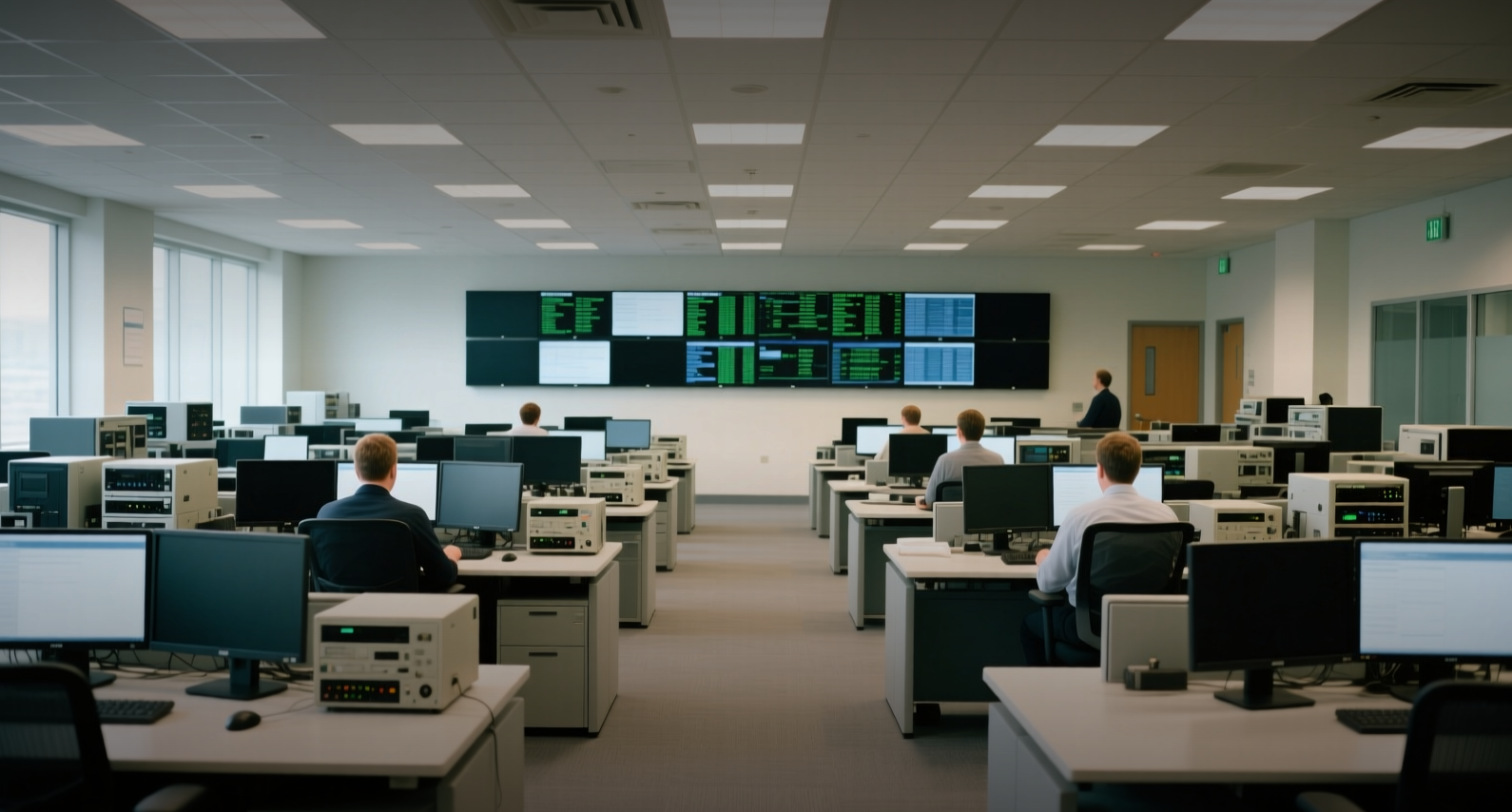
The distinction Huang drew is economic, not technical. Coding assistants respond to prompts and stop; security agents monitor networks continuously, which means customers pay for inference around the clock rather than in bursts. That shift matters for Nvidia because sustained inference loads consume GPU capacity differently than episodic developer queries — and because Huang framed the opportunity as a business line rather than a public-service obligation. "What better way to create demand than to create a problem," he said. "Who doesn't want their market to be hysterical about their product and line up around the corner for it?"
SafeMind runs on Nvidia's Nemotron models
The thesis has a product attached. On Sept. 1, nine days before Huang's remarks, Nvidia and CrowdStrike unveiled SafeMind at CrowdStrike's Fal.Con 2026 event in Las Vegas. The system was built inside CrowdStrike's Cyber Superintelligence Lab and runs on Nvidia's Nemotron large language models, designed to detect threats faster and with greater precision than conventional security tooling. Huang called CrowdStrike Nvidia's "number one cybersecurity partner" and the launch "an inflection point in cybersecurity."
The urgency framing rests on CrowdStrike's own telemetry: an 89% rise in AI-enabled cyberattacks over the past year, and a fastest recorded eCrime breakout time — the window between an attacker's initial access and lateral movement through a network — compressed to 27 seconds. Twenty-seven seconds is shorter than most human security teams can triage an alert, which is the core argument for autonomous agents over analyst-staffed security operations centers.
Nvidia has widened the partnership set beyond CrowdStrike, announcing AI security collaborations with Cisco and Palantir. In July 2026 it joined the Open Secure AI Alliance alongside Microsoft and IBM to develop open-source security tooling. The competitive field is filling in from the other direction as well: OpenAI chief financial officer Sarah Friar said at the same conference that her company sees cybersecurity as a major commercial opportunity, putting a second major AI platform vendor on record chasing the same enterprise budget line.
The 70% growth target is the number that matters
For investors, the practical question is whether security inference revenue is additive to Nvidia's data center franchise or a re-labeling of demand that would have arrived anyway. Nvidia's 70% revenue growth target for the coming fiscal year is the benchmark against which the cybersecurity narrative will be judged, and Huang's conference appearance came after the company issued a long-term forecast last month that reinforced Wall Street's view that AI data center spending continues. The company also announced plans to acquire Hugging Face for approximately $13 billion, extending its reach into model tooling and raising questions about whether its dealmaking distorts the market it supplies. Huang rejected the circularity charge directly: "It's not circular because we put a little bit of money in and a lot of money comes back."
The read-through for security software is more immediate than for Nvidia itself. If always-on agents become the default architecture, vendors with large telemetry datasets and existing enterprise distribution — CrowdStrike, Palo Alto Networks, Cisco — are positioned to price AI tiers on consumption rather than seats, a model that raises revenue per customer but also invites scrutiny when detection accuracy is hard to verify independently. Nvidia did not disclose benchmark methodology for SafeMind's precision claims, and no third-party evaluation of the system has been published.
Huang's record as a demand forecaster is the reason the remarks moved the conversation at all. He called accelerated computing and then generative AI before either became consensus, and his conference appearances have repeatedly reset positioning across semiconductors, software, and security names in the same session. That bellwether effect cuts both ways: the narrative now has a measurable test attached, and the fiscal-year growth target gives investors a date by which the cybersecurity contribution either shows up in the numbers or does not.
This article is for informational purposes only and does not constitute investment advice.