
Japanese equities opened the week sharply lower as Fed rate hike expectations and chip-sector weakness converged.
Japanese equities opened the week sharply lower as Fed rate hike expectations and chip-sector weakness converged.
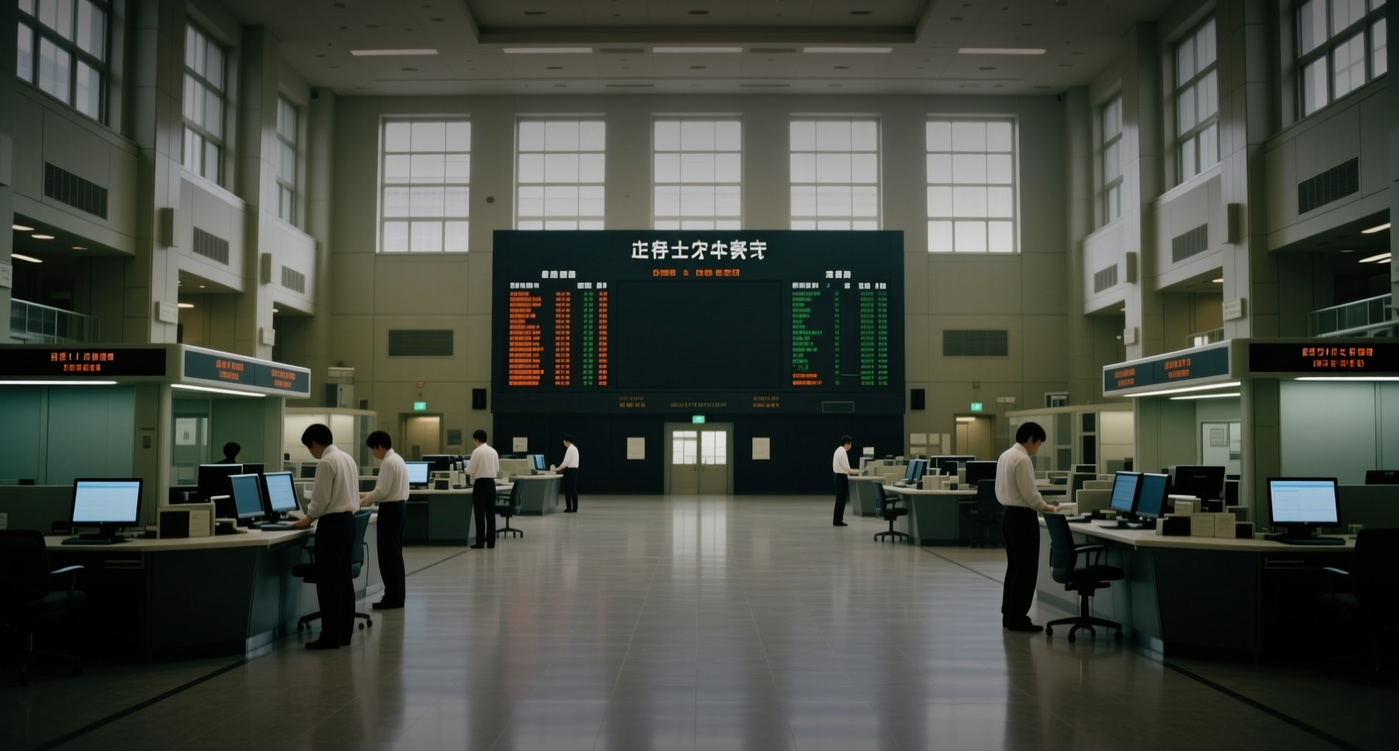
The Nikkei fell 2.2% to 64,930.03 as chip stocks led declines after Fed Chair Warsh's speech raised U.S. rate hike prospects.
"The index has been affected by overseas factors, not local cues," said Kazuaki Shimada, chief strategist at IwaiCosmo Securities. "If corporate outlooks are strong, the index's trend may change."
Advantest fell 7.8%, SoftBank Group dropped 4.2% and Tokyo Electron declined 3.8%. The dollar strengthened to 160.00 yen, up from 159.48 at Friday's Tokyo close. Investors are also watching developments in the Iran conflict after U.S. forces attacked two Iranian rocket launchers in the Strait of Hormuz on Sunday.
The selloff extends a volatile stretch for Japanese equities, which have been buffeted by AI spending concerns and shifting expectations for global monetary policy. The 10-year Japanese government bond yield climbed to 2.950% on Monday, the highest since October 1996, bringing the psychologically important 3% threshold into view.
Warsh, speaking at the Jackson Hole Symposium on Aug. 28, expressed concern about persistently elevated inflation and left the door open for additional rate hikes. Market expectations for a U.S. rate increase in September strengthened, pushing U.S. long-term yields higher at the end of last week. That momentum carried into the Tokyo market at the start of the week, triggering selling in Japanese government bonds.
The yield on newly issued 10-year JGBs opened at 2.930%, up 0.010 percentage point from the previous Friday's close, before selling pressure intensified and pushed it to 2.950% during the morning session. If long-term yields reach 3%, it would mark the highest level since September 1995. As a benchmark directly tied to mortgage rates and corporate borrowing costs, the impact on household finances and corporate funding is beginning to draw attention.
The decline in bond prices also reflects market views on the Bank of Japan's monetary policy. With persistent inflationary pressure in Japan and speculation simmering that the BOJ will move toward additional rate hikes, rising overseas yields are pushing domestic Japanese rates higher. Some analysts point out that the BOJ's reduction in government bond purchases and concerns over Japan's fiscal situation are widening the room for yields to rise further.
The chip-sector selloff mirrors broader concerns about the sustainability of heavy AI infrastructure spending. Alphabet shares sank 7% overnight after the company reported higher spending plans while also burning cash, a dynamic that has weighed on tech valuations globally. The Nikkei has been heavily influenced by the tech-heavy South Korean KOSPI and the U.S. Philadelphia semiconductor index in recent weeks, with the index losing nearly 8% in July before stabilizing.
The selloff in Japanese chip names extends a pattern that has defined the Nikkei's recent trajectory. Semiconductor test equipment maker Advantest, a key supplier to the AI supply chain, has been among the most volatile large caps, while SoftBank Group's outsized exposure to tech startups has increased its sensitivity to shifts in global risk appetite. Tokyo Electron, the country's largest chip equipment maker, tracks the U.S. semiconductor cycle closely.
Geopolitical risk adds another layer of uncertainty. U.S. forces attacked two Iranian rocket launchers in the Strait of Hormuz on Sunday, escalating tensions in a region critical to global oil shipments. Any disruption to crude flows through the strait would feed inflation pressures and could reinforce the case for tighter monetary policy, a scenario that would further pressure equity valuations.
This article is for informational purposes only and does not constitute investment advice.
