
Russian imports from the Maldives surged to $630 million in 2022, exposing a transit route for restricted Western goods that U.S. and EU officials now pressure Malé to shut down.
Russian imports from the Maldives surged to $630 million in 2022, exposing a transit route for restricted Western goods that U.S. and EU officials now pressure Malé to shut down.
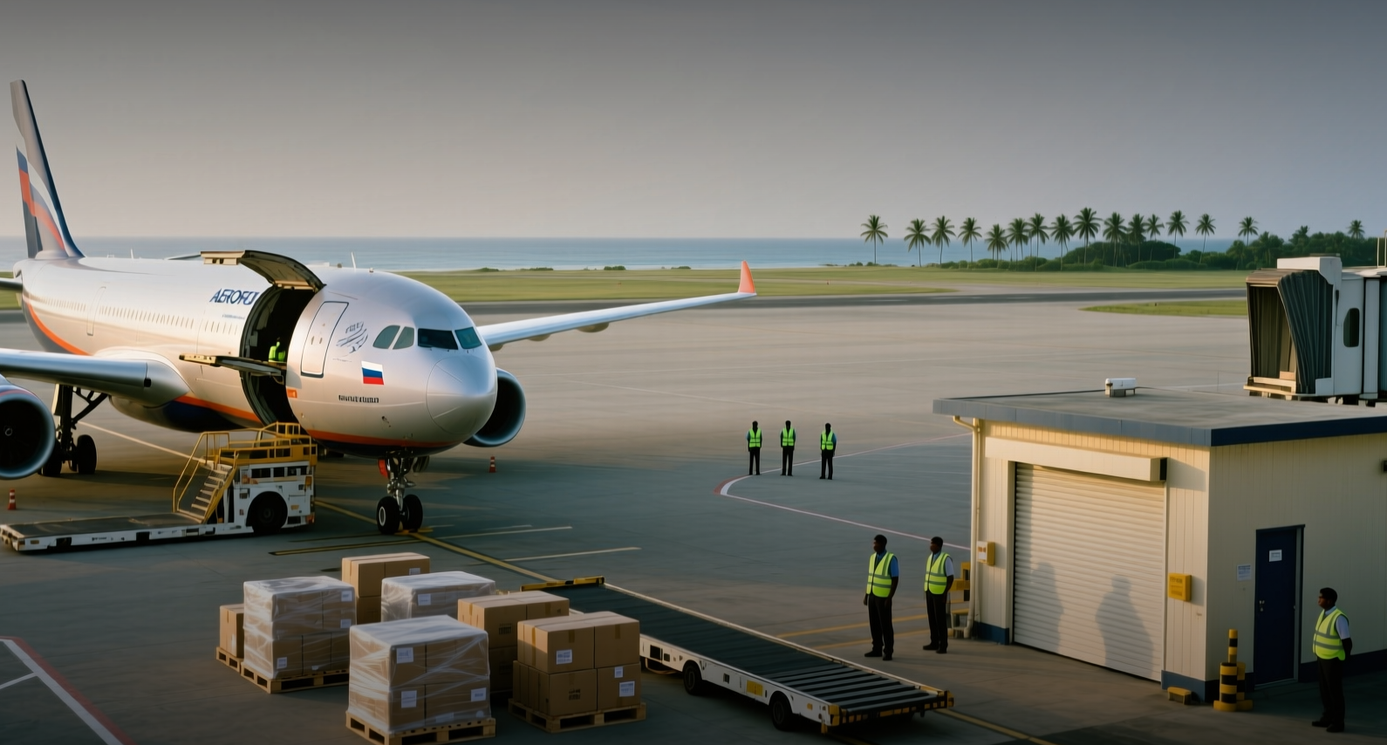
A web of local logistics firms at Malé's airport has helped route hundreds of millions of dollars in restricted Western goods to Moscow, with Russian import data showing the island nation's trade surged to $630 million in 2022 from under $7 million a year earlier.
"This shows there are effective channels that exist far outside of the usual suspects," said Pavlo Shkurenko, a sanctions research fellow at the Kyiv School of Economics Institute.
The Wall Street Journal investigation found that logistics companies at Malé's Velana International Airport help alter shipping documents to move restricted goods onto Aeroflot flights to Moscow. Russian imports from the Maldives reached $160 million in 2024, the last full year of available data, before Russian authorities blocked access to trade statistics in early 2025. The route is small compared with the roughly $15 billion in restricted imports flowing annually through China, Turkey and the UAE.
The U.S. and EU have frozen about $300 billion in Russian central-bank assets and disconnected major lenders from Swift. Now they are escalating enforcement against third-country intermediaries — banks and logistics firms — that help move dual-use goods to Moscow. The Maldives' economy, heavily dependent on tourism revenue from Russian visitors, complicates enforcement.
Documents reviewed by the Journal — air waybills, a cargo manifest and emails between logistics companies — show how the system works. An Aeroflot commercial flight lands each morning at Malé, where local middlemen working with Russia-linked logistics firms help clear U.S., European and Chinese goods through customs. The cargo is loaded onto the return flight to Moscow's Sheremetyevo International Airport about two hours later.
Once in Russia, the products are distributed in some cases to sanctioned entities, including S7 Airlines and its maintenance subsidiaries, which have struggled to source replacement parts for aging aircraft. Shipments transiting through Malé have included microchips used in missile guidance systems, optical instruments for satellite tracking, and high-strength aerospace rivets suited for both commercial jetliners and jet fighters.
Customs records from the Maldives show only about $2,300 of tuna and $25 in leaflets exported to Russia between 2022 and 2025 — a country with virtually no industrial base. Yet Russian import data collected by Import Genius, a U.S.-based research firm, shows imports from the Maldives surged to $630 million in 2022, the year the full-scale invasion began, from less than $7 million in 2021.
The U.S. and EU have focused recent efforts on closing loopholes and punishing circumvention. Both are increasingly targeting third-country intermediaries — including banks and logistics firms in nations that help route Western goods or illicit oil revenues back to Moscow. The Maldivian government is under growing pressure from Washington and Brussels to shut down the route, according to Western officials.
The customs office in the Maldives has limited staff, and goods transiting through the country undergo minimal checks. Cargo in transit typically doesn't undergo physical inspections; authorities rely on paperwork. A new air waybill is issued for the Malé-to-Moscow leg that doesn't list the name of the company that sold the goods.
Trade appears to be growing. In July, Maldives Airports Company reported a record 126 tons of freight transiting through the airport in a single day. Aeroflot accounted for 12 percent of outbound freight during the first half of the year, state-run PSM News reported. The airport operator made a record profit in 2024, becoming the most profitable state-owned company in the country.
The Maldives' economic dependence on Russia complicates enforcement. Russians make up the second-largest nationality among tourists, behind Chinese nationals, and the tourism sector is still recovering from the pandemic downturn. Diplomatic friction with Moscow would threaten the archipelago's primary revenue source.
William George, research director at Import Genius, said the figures probably understate the true volume of trade between the Maldives and Russia, noting that Russian authorities appeared to start censoring parts of the data in 2024 before blocking access entirely in early 2025.
The last time Western sanctions enforcement expanded to a new third-country hub — after the 2022 crackdown on transshipment through the UAE — restricted imports through that channel fell sharply within months, according to trade data. Whether the Maldives route closes as quickly depends on how much political capital Malé is willing to spend against Moscow.
This article is for informational purposes only and does not constitute investment advice.
