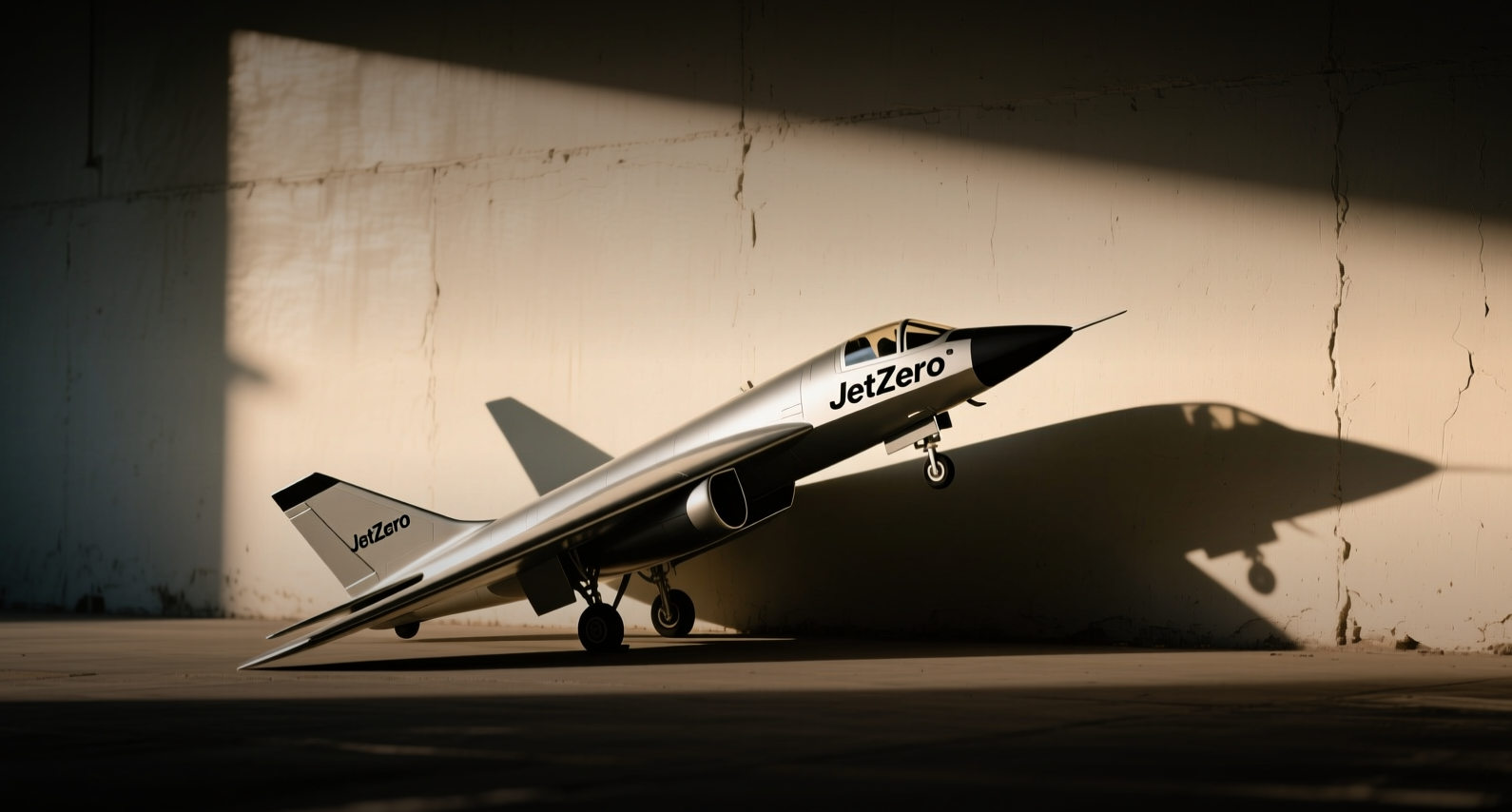
JetZero's radical blended-wing aircraft, the Z4, just won backing from two international airlines and a $3 billion US government loan — the strongest signal yet that the first new commercial airframe design in decades may reach production.
JetZero's Z4 blended-wing aircraft promises 50% lower fuel burn than the Boeing 767 it aims to replace, a claim that attracted backing from Gulf Air of Bahrain and Japan Airlines alongside a $3 billion US government loan commitment from the Export-Import Bank.
"The Z4's potential for lower fuel burn and enhanced sustainability aligns with our long-term environmental goals," a Japan Airlines representative said.
The 250-seat Z4 uses a blended wing body design that eliminates the traditional tube-and-wing configuration, reducing aerodynamic drag. The updated design, called the Z4U by analysts at Leeham News, features a V-tail on a longer central fuselage, wider wing with winglets, and Rolls-Royce engines. JetZero targets entry into service in the early 2030s.
The $3 billion EXIM Bank letter of interest and airline commitments position JetZero to challenge Boeing and Airbus's duopoly in the middle-of-market segment, a category Boeing abandoned when it shelved the NMA project. JetZero's $4.7 billion manufacturing project in Greensboro, North Carolina, has already helped the state win a national economic development award from the International Economic Development Council.
The blended wing body concept has been studied for nearly a century, with NASA and US aerospace firms researching it since the early 1990s. The proliferation of composite primary structures since 2000 has helped address structural challenges that previously made the design impractical for commercial aviation. JetZero's Z4 is the most advanced attempt yet to bring a BWB airliner to market.
The design's advantages are straightforward: by merging the wing and fuselage into a single lifting surface, the Z4 reduces wetted area and interference drag. Leeham News analysis found the Z4's optimal cruise altitude sits about 10,000 feet higher than a comparable tube-and-wing aircraft, requiring engines adapted for high-altitude performance. Rolls-Royce is supplying powerplants for the program.
Boeing and Airbus have both expressed skepticism about BWB benefits. At the American Institute of Aeronautics and Astronautics convention in San Diego, executives from both duopoly manufacturers questioned whether the design's theoretical efficiency gains would materialize in production. JetZero and fellow BWB developer Natilus countered that the incumbents were protecting existing product lines.
The skepticism is understandable. Boeing acquired McDonnell Douglas in 1997, inheriting decades of BWB research, yet never commercialized it. Airbus has focused on incremental improvements to its A320 and A330 families. JetZero's challenge is not just engineering — it is proving that a startup can certify and manufacture a radically new aircraft type, something no company has done since the Concorde.
JetZero is privately held, so direct equity exposure is unavailable to most investors. But the program's success would reshape the commercial aerospace supply chain. Suppliers of composite structures, landing gear, and avionics for the 767 and A330 replacement cycle could see new demand. Boeing shares face a potential long-term competitive threat if the Z4 achieves its fuel burn targets and enters service on schedule. The $3 billion EXIM Bank commitment signals US government support for next-generation aviation manufacturing, a factor that could accelerate certification timelines.
This article is for informational purposes only and does not constitute investment advice.