
Key Takeaways: Iran and Iraq have formalized a security agreement, tightening Tehran's grip on Baghdad just as Washington moves to expand its energy foothold in the country.
Key Takeaways: Iran and Iraq have formalized a security agreement, tightening Tehran's grip on Baghdad just as Washington moves to expand its energy foothold in the country.
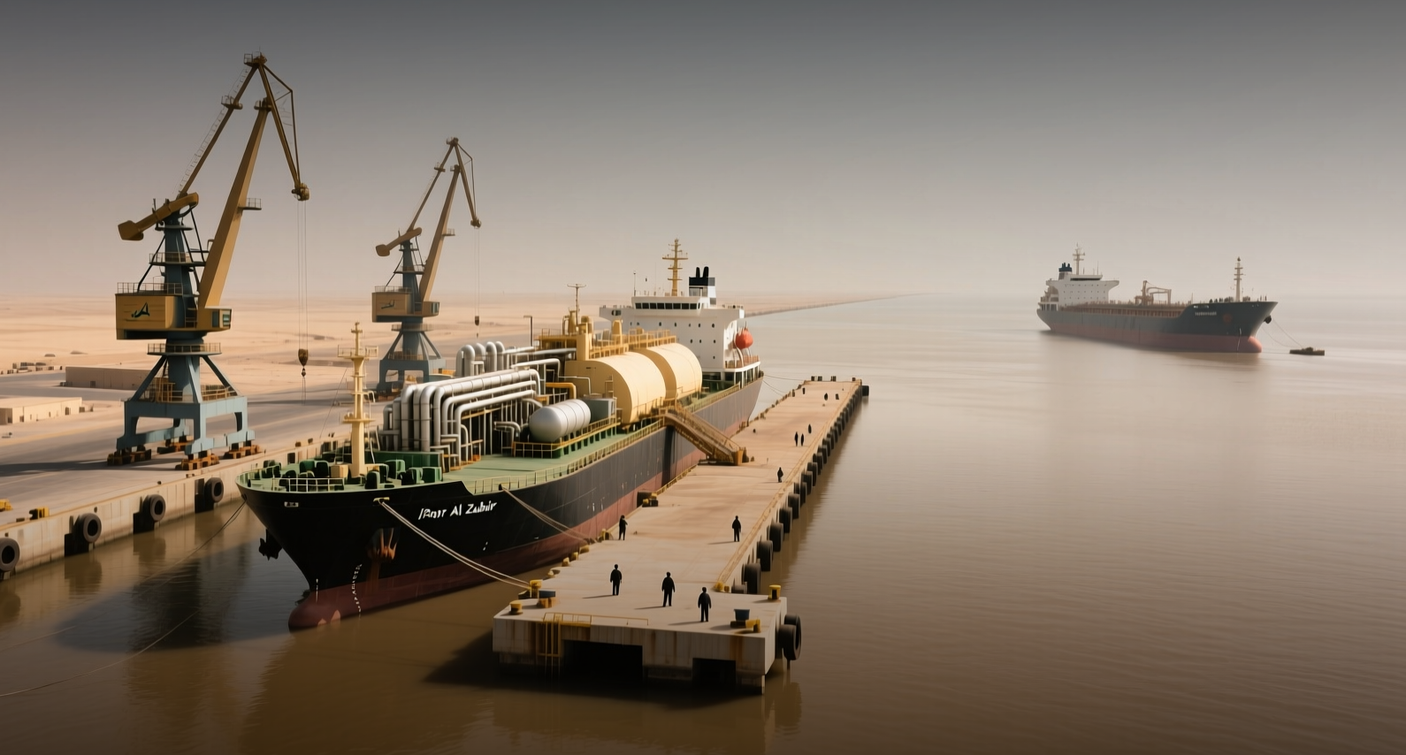
Iran and Iraq signed a security agreement, deepening bilateral ties as Washington invests $450 million in an LNG terminal at Iraq's Port of Khor Al Zubair. The pact, announced via Iranian state television, formalizes security cooperation between two neighbors whose relationship has defined Middle East geopolitics for decades.
"The US has to distinguish between degrading specific Iranian capabilities and trying to redesign the Iranian political system," said Andreas Krieg, associate professor of defence studies at King's College London. "That is where the historical record should make Washington extremely cautious."
The agreement comes as US-based Excelerate Energy prepares to build Iraq's first-ever LNG import terminal, with operations slated for the second quarter of 2027. The facility will handle a guaranteed regasification capacity of 500 million standard cubic feet per day, with Iraq committing to a minimum daily take of 250 MMscf/d. Over 90 percent of Iraq's government revenues still come from oil and gas, making energy infrastructure a critical lever of influence.
The security pact directly counters Washington's strategy to loosen Iran's and China's grip on Iraq. The US has long viewed Iraq as a client state of Iran since the 1979 Islamic Revolution, and more recently as being in thrall to Beijing through the 2019 "Oil for Reconstruction and Investment" agreement and the 2021 "Iraq-China Framework Agreement." With the Strait of Hormuz handling up to 30 percent of the world's oil and 20 percent of its LNG, the stakes for both Washington and Tehran could not be higher.
The US has been quietly building an energy foothold in Iraq as part of a broader strategy to reverse-engineer the Iran-Iraq relationship. Excelerate Energy, the global leader in LNG floating storage and regasification units, signed a fully integrated agreement with Iraq's Ministry of Electricity with an initial budget of $450 million. The company will be the sole commercial developer of the floating LNG infrastructure project, managing all engineering, procurement, dredging, and site clearance activities at the port.
The US strategy extends beyond energy infrastructure. Washington sees establishing one of the world's major LNG hubs in Iraq as a way to loosen Iran's and China's grip on Baghdad, and to place Iraq at the center of a new push to expand the Abraham Accords between Arab states and Israel. The US today remains the world's largest LNG exporter, processing around 18 billion cubic feet per day, with the Energy Information Administration projecting export capacity will double by 2031 compared with 2024 levels.
The security agreement between Iran and Iraq is not without historical precedent. The two countries fought a devastating eight-year war from 1980 to 1988 that killed hundreds of thousands. Since then, Iran has built deep economic, political, military, and religious ties with Iraq, particularly in the southern part of the country. Several of the two countries' major oil fields are part of shared reservoirs, making the energy relationship particularly intertwined.
The last time Washington attempted to reshape Iran's regional influence through Iraq was the 2003 invasion that removed Saddam Hussein. That intervention, which cost an estimated $5.8 trillion over two decades of war in the Middle East, inadvertently created the political space through which Iran's Islamic Revolutionary Guard Corps built much of its post-2003 regional network, according to Krieg.
"Destroying a government is far easier than controlling what follows," said Negar Mortazavi, senior fellow at the US-based Center for International Policy. "Yet Washington has repeatedly confused military power with political control and regime removal with victory."
The security pact between Iran and Iraq shows that Tehran is not standing still. As the US-Israel war on Iran continues, with the Strait of Hormuz as the primary flashpoint, the agreement gives Tehran a formalized security framework with its most important neighbor. For oil markets, the pact adds another layer of complexity to an already volatile regional picture, where the closure of the Strait of Hormuz has upended global energy supply chains.
This article is for informational purposes only and does not constitute investment advice.
