

Google DeepMind's new robotics AI family gives humanoid machines the ability to reason, plan, and collaborate in real time — a step toward what the lab calls "physical AGI."
Google DeepMind's new robotics AI family gives humanoid machines the ability to reason, plan, and collaborate in real time — a step toward what the lab calls "physical AGI."
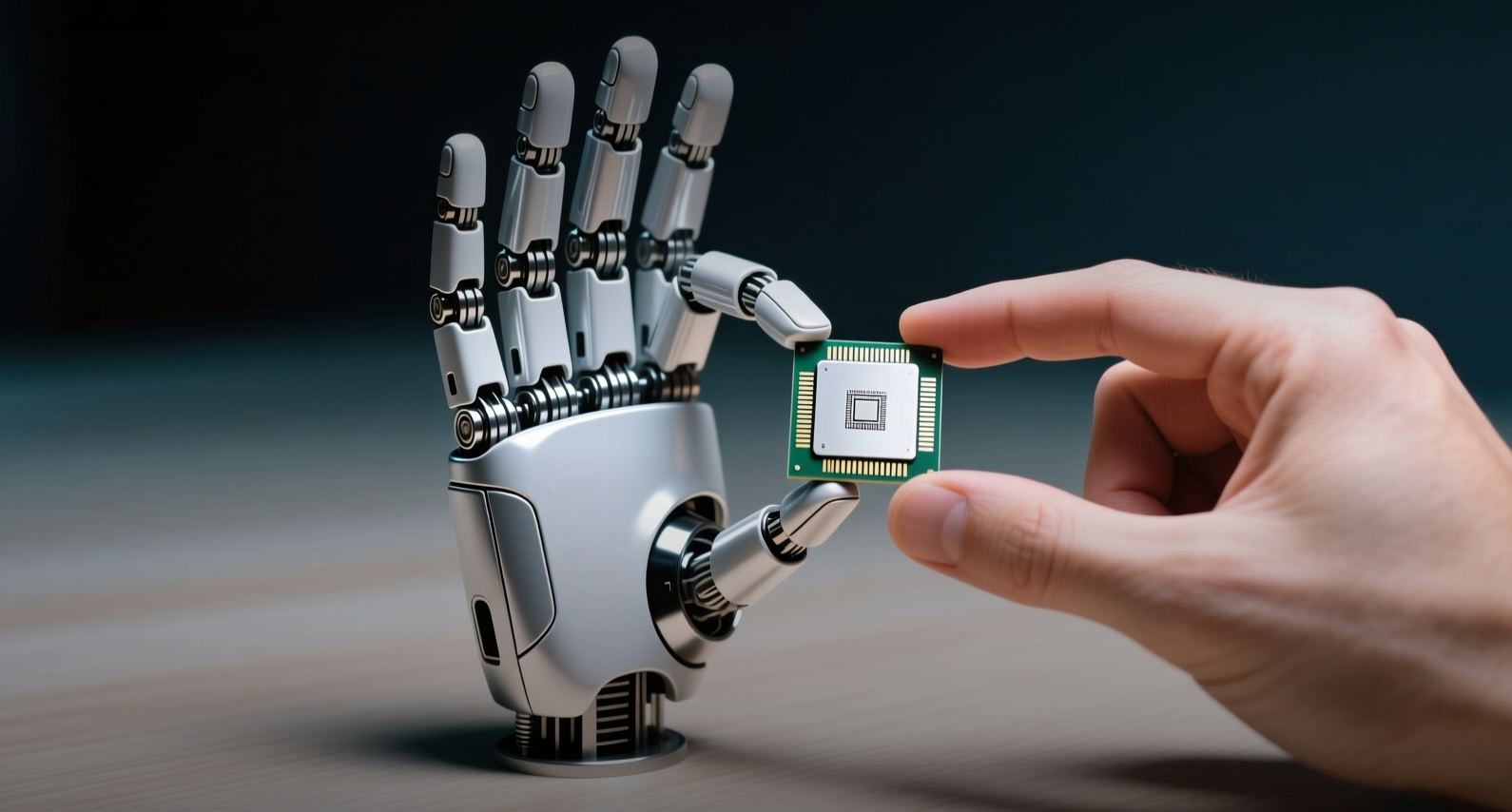
Google DeepMind released a three-model robotics AI family that enables humanoid robots to coordinate full-body movement while reasoning about tasks, bringing machines closer to human-level dexterity in physical environments.
"It's another milestone in our path towards really getting towards what we call physical AGI, which means we get a robot to do anything that a human can," Carolina Parada, head of robotics at Google DeepMind, told WIRED.
The flagship Gemini Robotics 2 model controls full humanoids from feet to fingertips, while Gemini Robotics ER 2 handles high-level planning over a live video feed with a 128,000-token context window. A third model, On-Device 2, runs locally and adapts to new bi-arm robots in hours from fewer than 200 examples. In tests, Apptronik's Apollo 2 fitted with Inspire hands picked objects from shelves 76.3% of the time and from tables 68.4% of the time. Five-fingered dexterity with the 22-degree-of-freedom SharpaWave hand proved harder: 92% for unscrewing a light bulb but just 36% for screwing one in and 44% for tying a trash bag.
The release positions Google to compete for a share of the physical AI market, where robots could eventually handle warehouse sorting, facility inspection, and lab tasks. Demis Hassabis, Google DeepMind's chief, has said he wants to build an AI operating system for robots similar to Android for smartphones — a vision that would give Google a platform-level stake in any company building hardware.
ER 2 Brings Continuous Video Reasoning
The ER 2 model, based on Gemini 3.5 Flash, processes live video rather than still frames, allowing it to judge task completion — a capability that has quietly limited robot autonomy. It classifies progress into five completion bands with 57.4% accuracy and pinpoints critical moments, such as when a cup is full enough to stop pouring, with 91.3% accuracy and a mean error of 0.96 seconds. The model streams through the Gemini Live API's bidirectional endpoint, keeping inference latency low enough for physical control.
ER 2 also enables multi-robot collaboration. In demonstrations, Apollo 2 worked alongside a Franka Duo bi-arm platform, sharing a semantic understanding of a task and handing work between machines. A separate demo showed ER 2 driving navigation and manipulation APIs on Boston Dynamics' Spot to fetch objects on spoken command.
Safety Guardrails and Deployment Boundaries
Google introduced ASIMOV-Agentic, a benchmark that measures whether a reasoning model behaves safely as an orchestrator — refusing unsafe tool calls, judging physical feasibility, and asking for human help when uncertain. ER 2 halts a humanoid when a person approaches and resumes once the area is clear, a requirement in collaborative safety standards that is usually met in hardware rather than planning models.
The model card bars developers from using the robotics models for safety-critical work, naming healthcare and transportation specifically. That points the first wave of deployments toward inspection, warehouse handling, and lab tasks — environments where a malfunction carries lower risk.
Competitive Dynamics and Talent Shifts
Although Anthropic and OpenAI have led in chatbots and coding tools, Google has a stronger track record in robotics research, having previously partnered with Boston Dynamics to provide AI for legged machines. The robotics push comes as DeepMind dismantles its Nobel-winning AlphaFold team, reassigning most original authors to Gemini projects. John Jumper, who shared the 2024 Nobel Prize with Hassabis, left for Anthropic in June, along with two core AlphaFold researchers.
Alphabet shares trade at roughly 22x forward earnings. The robotics models are unlikely to generate material revenue in the near term, but they strengthen Google's position in the physical AI race — a market that could reshape automation spending across logistics, manufacturing, and healthcare. If Google's robot operating system vision succeeds, the company would collect a platform tax on every humanoid sold, similar to Android's economics in smartphones.
This article is for informational purposes only and does not constitute investment advice.
