
Flock Safety's AI cameras — more than 13,000 across Texas — face a bipartisan revolt county officials say they can't reverse.
Flock Safety's AI cameras — more than 13,000 across Texas — face a bipartisan revolt county officials say they can't reverse.
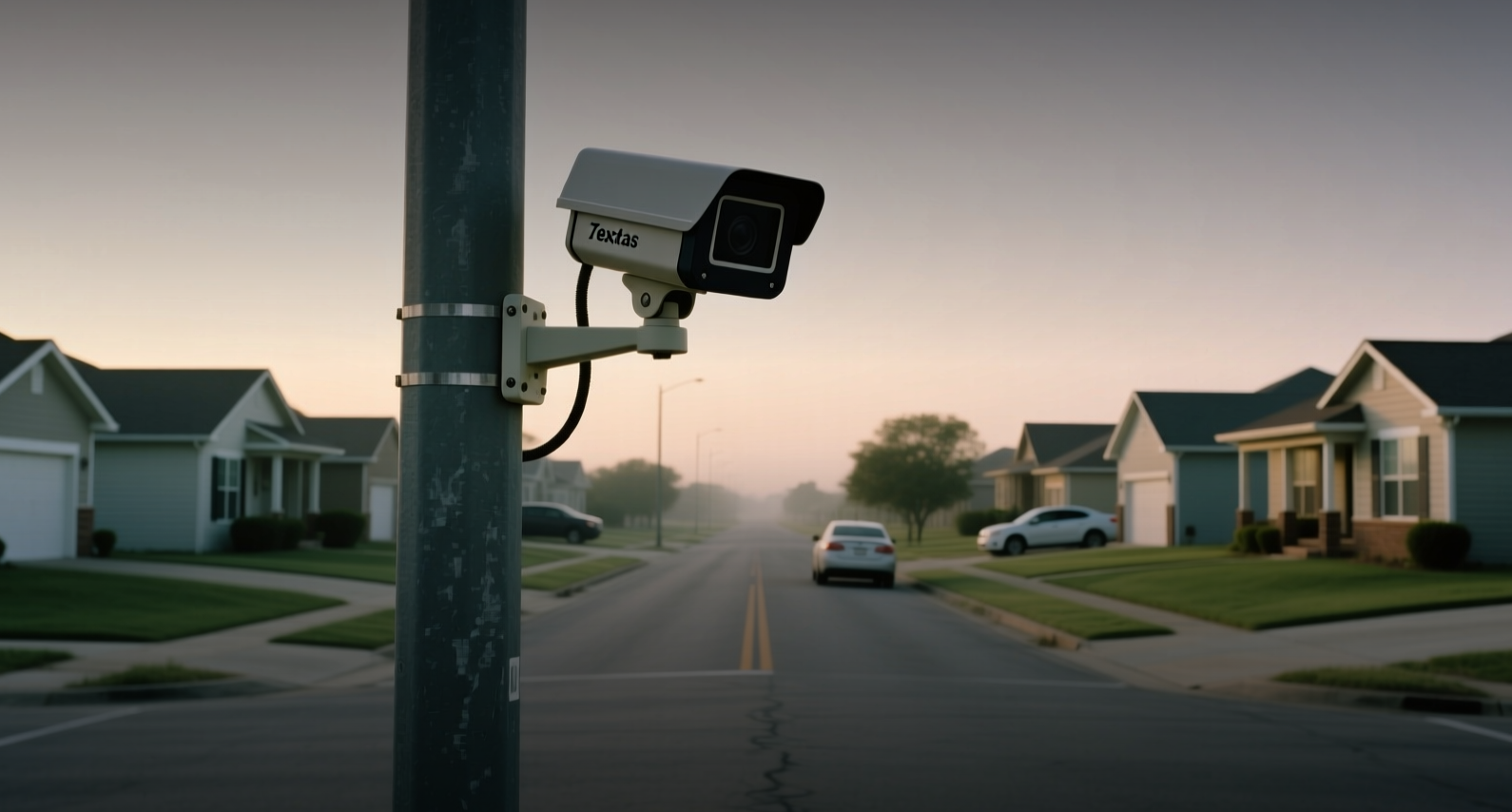
Flock Safety's AI license-plate readers — more than 13,000 cameras across Texas — face a bipartisan backlash after a string of law-enforcement abuses, yet county officials say restrictive contracts make removal nearly impossible.
"Public safety and privacy are not mutually exclusive. Residents deserve both, and county policy should protect both," Harris County Commissioner Rodney Ellis said.
Flock uses artificial intelligence to scan every passing vehicle, uploading plate numbers, car models, color and even bumper stickers to what the company calls the country's largest vehicle surveillance database. Law enforcement agencies can search that database without a warrant. The Harris County sheriff's office manages 20 Flock networks with 480 cameras, the most in the state, while the Texas Department of Public Safety approved a $26 million contract last year to support Operation Lone Star.
The backlash has already cost Flock contracts in Guadalupe and Hood counties, plus cities including Bandera, Lago Vista and Magnolia. But the company's multiyear agreements — Harris County's runs through June 2027 at roughly $869,000 — and fragmented ownership across municipal districts and homeowners associations limit what any single vote can accomplish.
The abuse record
The tipping point came in 2025, when a Johnson County sheriff's deputy used the nationwide network of more than 83,000 Flock cameras to track a woman suspected of attempting to get an abortion. The district attorney's office declined to press charges after a medical examiner found the biological matter was a blood clot, not a fetus. Since then, misuse cases have leaked out steadily.
Earlier this month, the Harris County Sheriff's Office blocked three deputies from using Flock while it investigates possible misuse. A Fort Bend County deputy was suspended after looking up one person's plate 41 times and another 148. A Pasadena sergeant resigned after allegedly using Flock to track and stalk a fellow officer. The Deer Park Police Department suspended an officer who admitted to misuse.
"The license plate readers have thwarted kidnapping attempts, led to the quick apprehension of armed robbery crews, and helped recover countless stolen vehicles," Harris County Sheriff Ed Gonzalez said in a news release. "But as with any powerful new public safety tool, this technology is subject to abuse."
Who owns the cameras
The central obstacle to removal is ownership. Most Flock cameras in Texas are not purchased by law enforcement at all. Retailers, homeowners associations and municipal utility districts buy their own systems and then choose whether to share footage with police. According to the Harris County sheriff's office, most camera networks are owned by municipal utility districts and neighborhood associations, with the sheriff's office acting as system administrator.
That fragmentation means county officials would have to track down every owner and persuade each to break a contract with Flock. The company has made that harder: ACLU Georgia reported this year that Flock changed its terms to make exit more difficult, and the new agreements give Flock a perpetual right to use customer data even after termination, with no expiration date.
Flock has responded to the pressure by shortening default data retention from 30 days to seven, requiring a case code before any search and adding an "Evidence Mode" for active investigations. Dallas police, however, plan to keep Flock data for a full year, saying investigations need more time.
Some officials are doubling down. Harris County Commissioner Adrian Garcia, a former sheriff, defended the system after the county renewed its contract until 2027. Dallas Police Chief Daniel Comeaux has defended the city's 650 Flock cameras. Texas Municipal Police Association liaison John Wilkerson said recording in public is a protected right and criticized the vandalism of cameras — Dallas has logged roughly 25 incidents in five months, mostly camera poles cut down.
U.S. Rep. Keith Self, a McKinney Republican, proposed legislation last month to require federal agencies to obtain warrants before accessing Flock data. Conroe residents are pushing for a November ballot measure to remove the cameras, and the League City mayor has floated a similar idea.
For Flock, the stakes are measurable. The company says some 5,000 law enforcement agencies and 6,000 communities use its products nationally. Texas alone represents a $26 million state contract plus hundreds of local deals. If the backlash translates into legislation — Self's warrant bill, or local ballot measures — it could slow the company's expansion in its largest market.
This article is for informational purposes only and does not constitute investment advice.
