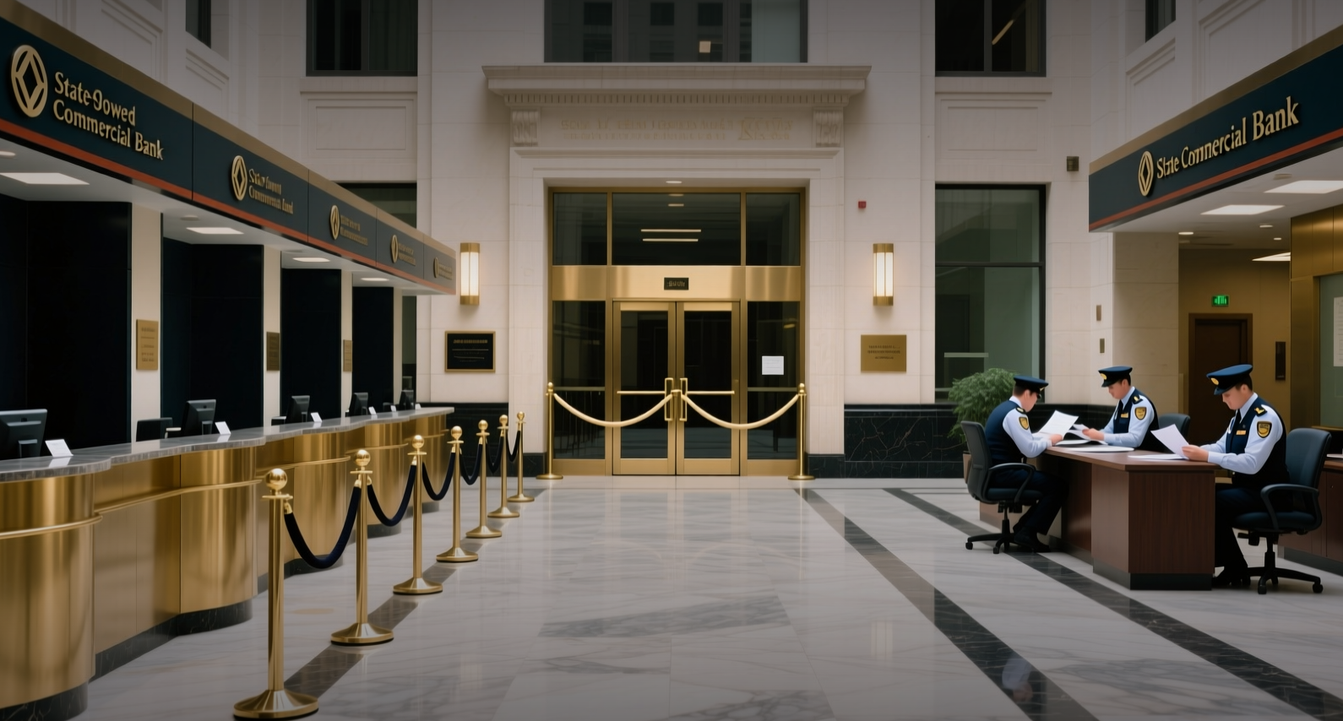
Beijing is funneling RMB300 billion of special treasury bond proceeds into eight central financial enterprises, a recapitalization sweep that industry sources describe as the most sweeping single capital injection the financial system has seen in years and one whose announced RMB360 billion of placements ran ahead of both the bond quota and market forecasts.
The recipient list broke beyond large state-owned banks for the first time, spanning two commercial lenders, four insurers and two policy institutions. "This is a forward-looking arrangement to prepare for a rainy day, supporting the high-quality development of central financial enterprises and helping the macro economy maintain stable long-term growth," industry sources told Xinhua News Agency.
Industrial and Commercial Bank of China plans to raise up to RMB100 billion through an A-share placement, with the ministry subscribing RMB70 billion and China National Tobacco Corp. and four regional tobacco units taking the rest. Agricultural Bank of China targets up to RMB160 billion, of which the ministry will take RMB130 billion. China Life Group receives RMB35 billion directly, PICC up to RMB15 billion, China Taiping RMB7 billion, the Export-Import Bank of China RMB30 billion, Sinosure RMB10 billion and China Re RMB3 billion.
The injection is estimated to lift the average core tier-1 capital ratio of ICBC and ABC by about 0.6 percentage points, below the 1.0-point gain from the first batch, according to CICC. ICBC's core tier-1 ratio stood at 13.21 percent as of June 30, 2026, with a tier-1 ratio of 14.43 percent and a total capital adequacy ratio of 18.57 percent, all above minimum regulatory requirements.
RMB300 Billion to Leverage About RMB4 Trillion
CICC previously estimated the RMB300 billion of capital could support roughly RMB4 trillion of asset expansion, strengthening direct credit issuance and external merger capacity while supporting the real economy and guarding against financial risk. The injection equals about 0.7 years of the banks' internally generated capital replenishment and 2.2 years of dividend scale, Shenwan Hongyuan Securities noted.
The 2026 Government Work Report proposed issuing RMB300 billion of special sovereign bonds to support large state-owned commercial banks in replenishing capital. The first round in 2025 deployed RMB500 billion of special bonds, with RMB520 billion ultimately raised by Bank of China, China Construction Bank, Bank of Communications and Postal Savings Bank of China. Combined with this round, cumulative injections across the two batches exceed RMB800 billion.
Tobacco System Bridges the Funding Gap
The RMB360 billion of announced placements exceeds the RMB300 billion bond quota by RMB60 billion, a gap filled by direct subscriptions from the tobacco system, which is injecting RMB30 billion each into ICBC and ABC. The combination of special bond proceeds and state-owned entity capital lets Beijing bridge the shortfall without raising the issuance quota, reflecting a more flexible coordination between fiscal policy and specific state-owned capital.
The delayed timing relative to last year, when injections were completed by late June, stems partly from the complexity of designing diversified schemes across more institutions and higher cross-departmental coordination costs, Guolian Securities said. The broader recipient base and the entry of cross-sector funders extended the preliminary approval cycle.
For equity investors, the placements dilute existing shareholders, but the trade-off is stronger balance sheets. With net interest margins narrowing across the industry as rate liberalization deepens, the capital buffer lets the six major banks sustain credit support for the real economy and maintain relatively stable dividend capacity, while the insurers gain solvency headroom to deploy medium- and long-term funds as a ballast for capital markets.
This article is for informational purposes only and does not constitute investment advice.