

Apple's M6 Mac mini is the first 2nm-process computer, delivering up to 40 percent faster multithreaded performance than the M4 at an $899 starting price.
Apple's M6 Mac mini is the first 2nm-process computer, delivering up to 40 percent faster multithreaded performance than the M4 at an $899 starting price.
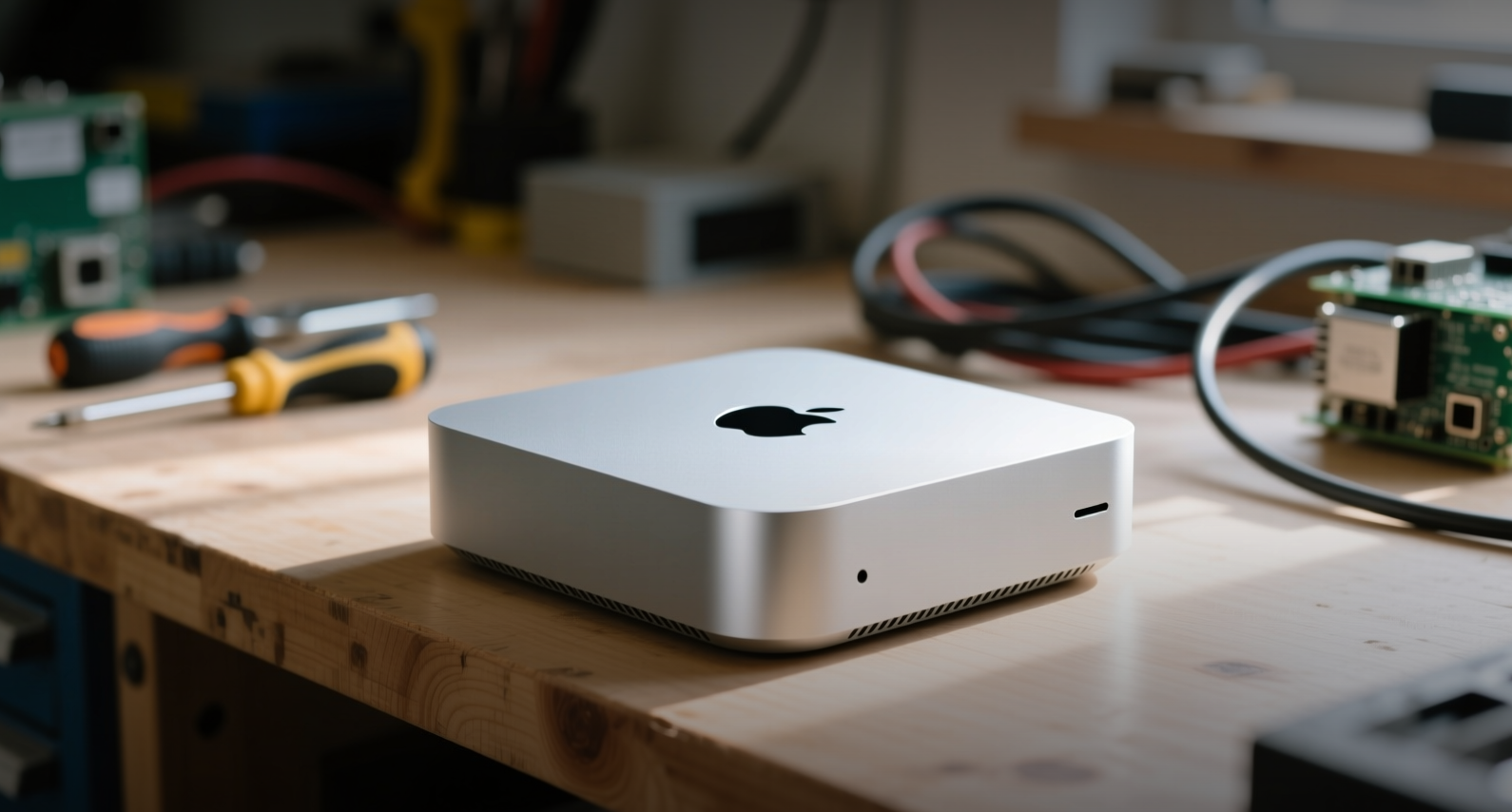
Apple's new Mac mini becomes the first 2nm-process computer, with the M6 chip delivering up to 40 percent faster multithreaded performance than the M4 and 4x faster AI workloads, starting at $899.
"The M6 offers the world's fastest single-threaded performance," Apple said in its announcement, marking the first time its base desktop uses all three CPU core types — two super cores, four performance cores and six efficiency cores. Bloomberg's Mark Gurman had predicted the Mac mini refresh but not the simultaneous Mac Studio upgrade to the M5 Ultra.
The M6 packs a 12-core CPU and 12-core GPU, two more cores than the M4 and M5, with memory bandwidth rising to 170GB/s from 120GB/s on the M4. Apple brings its Neural Accelerators to the base Mac mini for the first time, claiming up to 4x faster AI performance and 2x faster graphics than the M4, alongside a dual 16-core Neural Engine. The higher-spec Mac mini pairs the M5 Pro — up to 18-core CPU and 20-core GPU with third-generation ray tracing — supporting 64GB of unified memory at 307GB/s. Both models are available for pre-order today and ship September 22.
The $899 base price is a $100 increase over the M4 Mac mini, though education pricing starts at $799. The 2nm node, produced by TSMC, packs more transistors on a smaller die for better power efficiency — a commercial deployment that pressures rivals including Qualcomm and Intel to accelerate their own advanced-node roadmaps. In China, the M6 Mac mini starts at 6,999 yuan.
The 2nm process marks Apple's first commercial use of the node, following the M5 family built on 3nm. Apple claims the M6 runs up to 1.2x faster multithreaded than the M5 and up to 2.4x faster than the M1. The dual 16-core Neural Engine is up to 2x faster than the previous generation, turning the base Mac mini into an on-device AI workstation rather than an entry-level desktop.
Apple also upgraded the Mac Studio, swapping the M4 Max and M3 Ultra for the M5 Max and the new M5 Ultra — which Apple calls its most powerful silicon ever, with Neural Accelerators in an Ultra chip for the first time. Apple says the M5 Ultra can color-grade uncompressed 8K footage in real time. The base Mac Studio holds at $2,499, while the M5 Ultra configuration starts at $5,499, a $200 increase over the M3 Ultra.
Apple's 2nm deployment strengthens its position in the AI-enabled personal computing market, where on-device inference is becoming a differentiator. The move also cements TSMC's lead in advanced-node manufacturing, while the M6's absence of Pro, Max and Ultra variants — Apple is reportedly accelerating the M7 family — points to a faster chip cadence that could pressure Intel and AMD in the desktop segment. Apple shares have not yet reacted to the announcement.
This article is for informational purposes only and does not constitute investment advice.
