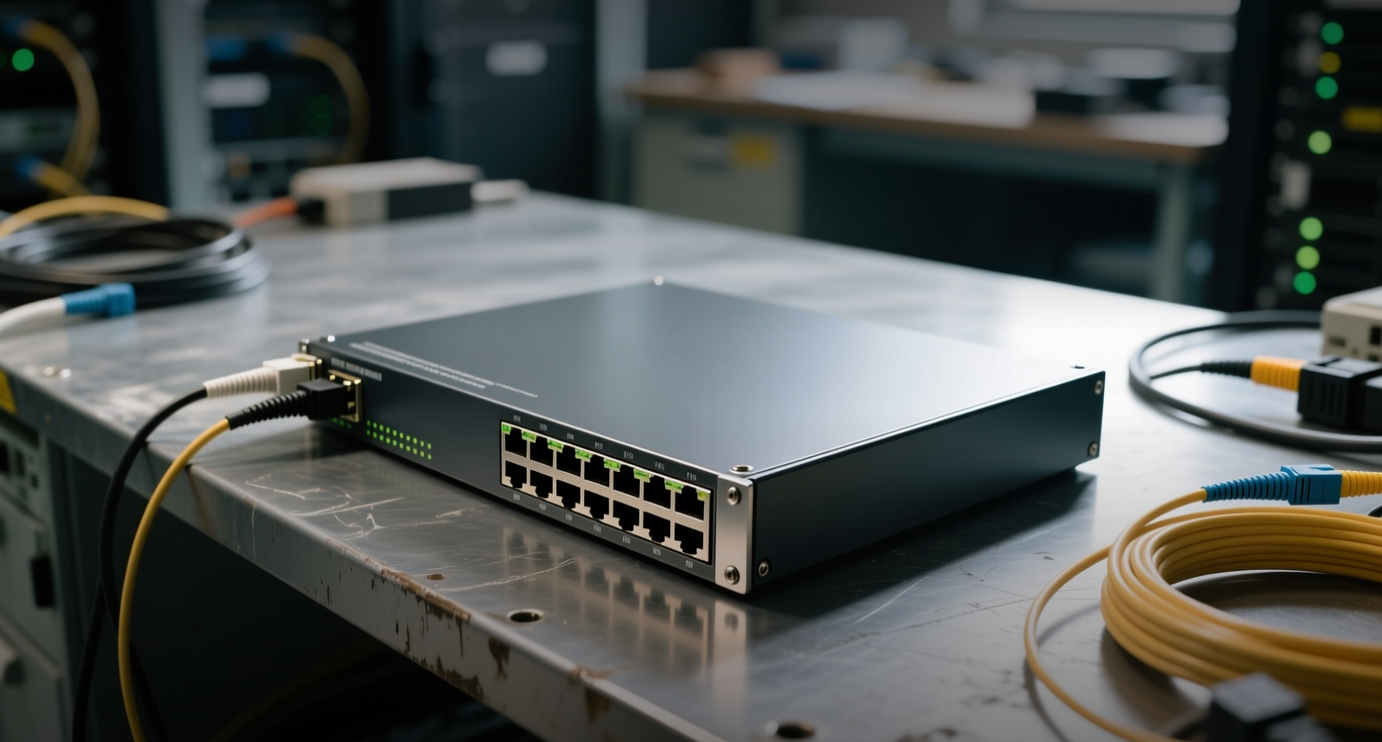
AI accelerators grab the headlines, but the money is increasingly flowing to the networking layer that connects them — and a handful of companies are quietly dominating that niche.
Investment capital is rotating into AI networking infrastructure as the five largest U.S. digital infrastructure providers project combined capital expenditure exceeding $700 billion in 2026 alone, according to Kelly Services' 2026 Data Center Salary Guide. The shift reflects a maturing AI investment thesis: hyperscalers have spent heavily on GPUs and accelerators, but the interconnect fabric binding those compute clusters together — switches, optical transceivers, and high-speed Ethernet gear — is emerging as the next bottleneck and the next profit pool.
"The biggest constraint on data center growth is no longer just power, land, or equipment. It's talent," Joel Leege, President of Kelly Science, Engineering, Technology & Telecom, said in the report. "Without the skilled workforce to build, commission, and operate these facilities, even the most ambitious AI infrastructure investments will struggle to move at the speed the market demands."
The networking opportunity is substantial. Kelly's report shows permanent data center employment is projected to reach 650,000 positions by 2026, a 30 percent increase from 2023, with data center-related construction jobs expected to exceed 180,000 positions through 2028. That buildout translates directly into demand for the networking hardware that ties AI clusters together — from top-of-rack switches to the optical modules carrying data between GPU nodes.
The competitive dynamics are intensifying. Kelly's data shows 25 percent of data center personnel are hired away by competing hyperscalers and data center operators, driving sector-wide wage inflation. National midpoint salaries for specialized roles reflect the scarcity: AI Engineers command $175,000, Data Center Operations Leaders $178,000, and Commissioning Program Managers $135,000. Geographic premiums compound the picture — Silicon Valley carries a 34.2 percent premium above the national average, while emerging energy corridors like Omaha sit 11.8 percent below.
The Networking Layer Becomes the Constraint
The infrastructure buildout is pushing networking technology forward. Teledyne LeCroy this month introduced Ultra Ethernet validation tools for AI and high-performance computing networks, including the Xena Z1608 Edun and Z800 Freya Ethernet Traffic Generators and the SierraNet M1288 Protocol Analyzer. These tools support link-layer retry, credit-based flow control, and stateful Ultra Ethernet protocol messaging — capabilities designed for the scale-up and scale-out fabrics that AI workloads demand.
Ultra Ethernet, an open Ethernet-based architecture built for AI and HPC environments, addresses the congestion management and reliability requirements that standard Ethernet was never designed to handle. As AI clusters scale from hundreds to tens of thousands of GPUs, the networking layer becomes as critical as the compute itself. Companies that control this "plumbing" — the switches, cables, and protocol stacks — are positioned to capture recurring revenue from every AI buildout.
The broader AI infrastructure wave extends beyond data centers. BCC Research reports that global investment in AI infrastructure has surpassed $650 billion, with AI reducing aerospace materials R&D cycles by 50 to 70 percent and unscheduled repairs by up to 40 percent through digital twins and predictive maintenance. North America leads AI adoption in advanced materials, anchored by defense-led funding, while Europe is mobilizing up to €200 billion ($226.2 billion) in EU-backed AI investments.
Investor Implications
For investors, the AI networking trade offers a different risk profile than the accelerator names. While GPU makers face cyclical demand swings and competitive pressure from in-house chip designs at hyperscalers, networking infrastructure benefits from a more durable demand curve — every data center, regardless of which accelerator it deploys, needs the same interconnect fabric. The companies dominating this niche trade at meaningful premiums to the broader semiconductor complex, reflecting the market's recognition that the "plumbing" is as essential as the processors.
The key question is whether the market has fully priced in the networking opportunity. With $700 billion in projected CapEx from the top five digital infrastructure providers alone, the demand runway extends well into 2027 and beyond. Companies that can supply the networking layer at scale — and navigate the talent constraints that Kelly identifies as the single largest bottleneck to data center deployment — are positioned to capture a disproportionate share of that spend.
This article is for informational purposes only and does not constitute investment advice.